

What do you do when you learn—half a century later—that your infant was treated like a lab animal? That your love was withheld not by accident but by design?
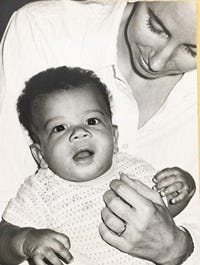
Fifty years after leaving Synanon, I discovered that my ten‑month‑old baby had been used in a sociological experiment. He was studied like a rhesus monkey while I was kept away from him. Researchers observed him, measured him, and left him in a room without adults while they took notes on his aggression, submission, and dominance.
I try to put Synanon behind me; I really do. But the only revelations that still trigger my PTSD involve my son, who was born in Synanon and was twenty‑seven months old when I finally picked him up from the 24/7 Synanon school and left.
When I wrote my memoir, Tender Loving Care: Escaping One of the Most Dangerous Cults in America, I came to terms with having lived in a cult. I forgave myself for allowing my baby to live in a communal school 24/7, for staying more than a year after he was moved 400 miles away from me, for missing his first steps and first words.
But I never understood why I was kept away from him. Why I had to arrange visits with my own son as though he were at boarding school.
Now I know.
In November 2025, I discovered that my son had been part of a federally funded research project. For seventeen months, he lived at a ranch in Marin County, California, where I believed he was being lovingly cared for. Instead, he was part of a study of aggression and dominance relations under grants from the National Institute of Mental Health.
Parents—not just me, but all of us—were kept away from our children during the study. The lead researcher even had her own baby in the school, yet she saw her child every day. I didn’t.
Was the separation intentional? Was it necessary for the study? Was it for the grant money? For $821,000 in today’s dollars?
I don’t know. But I know what happened to my baby.
The Study
The grant proposed “applying ethological tools of observation and analysis to the social behavior of 25 communally‑reared children, ages 6 months to 4 years.”
Ethology is the study of animal behavior. Before Synanon, the researcher had published papers on dominance relations in free‑ranging rhesus monkeys.
What an opportunity: apply methods developed for monkeys to human babies. To our babies. To my baby.
And none of us were told.
Across modern research ethics—psychology, medicine, education, child development—children cannot be observed or experimented on without informed consent. Yet Synanon received $134,849 from NIMH between 1974 and 1976 to study our children. No parent was informed. No parent consented.
Inside the Infant Program
The infants and toddlers were left alone in playrooms for most of the day. The Green Room, for babies six to eighteen months old, was filled with toys and climbing equipment. My son was barely crawling when he was placed with children already running and climbing.
Caregivers were forbidden to enter the room unless one child hurt another.
In the first three and a half months alone, researchers logged 492 hours of observation. They took notes on 66 types of aggressive behavior and 36 types of submissive behavior. They ranked the children in terms of dominance.
And the study went on for three years.
My friend Shari worked with the infants. I didn’t know her then, but she cared for my baby when Synanon moved him 400 miles away from me. She told me:
“We could only interfere if a child was biting or clobbering one of their peers. We had to observe them from windows in the doors of the Green Room or Orange Room. Two people were always watching—‘observing’—and writing everything down.”
She loved the children. She loved my son. But she was not allowed to comfort them except during feeding, diapering, waking, and bedtime.
Even during outdoor time, observers took notes. Shari felt inhibited, wary of interacting with the children—maybe they were taking notes on her, too.
The Separation
When I first placed my baby in the infant program, I visited him every day. I took him for walks along the Santa Monica Promenade. I played with him on the floor.
Three months later, Synanon moved him 400 miles away.
I was promised a job at the Marin County compound. I waited. And waited. And waited. My visits were limited to two hours every two or three weeks. Parents were discouraged from visiting. Logs were kept on how long we stayed. If we stayed too long, caregivers fudged the logs to protect us.
I missed his first steps. His first words. His first everything.
I believed I was giving him a magnificent life. I believed the communal school was like a kibbutz. I believed the propaganda.
I didn’t know the school had become a laboratory.
The Findings
The published papers state that Synanon children showed higher levels of aggression than nursery‑school children. The researchers noted a “linear dominance hierarchy” among children aged six months to four years—something seen in primate studies but not in preschool children.

Of course they did. The children were left alone together all day, with no adult comfort except during basic care.
The Harm
For decades, I carried crushing guilt for leaving my baby in others’ hands. Now the guilt is gone—replaced by simmering anger.
Shari told me:
“The school was a warped, cruel, inhumane experiment designed to prove your devotion to Synanon over the most important relationship in a person’s life.”
I thank God that most of the Synanon children proved remarkably resilient. Many built lives filled with meaning and love.
I don’t believe that happened because of the researchers.
I believe it happened because they were loved by caregivers like Shari.
Justice ?
It has been fifty years. Speaking up won’t erase what happened. It won’t undo the harm.
But maybe it will tell the children who lived through it what they deserved to hear all along:
Someone noticed. You mattered. You were wronged.
What a horrific story. How did you ever find out?